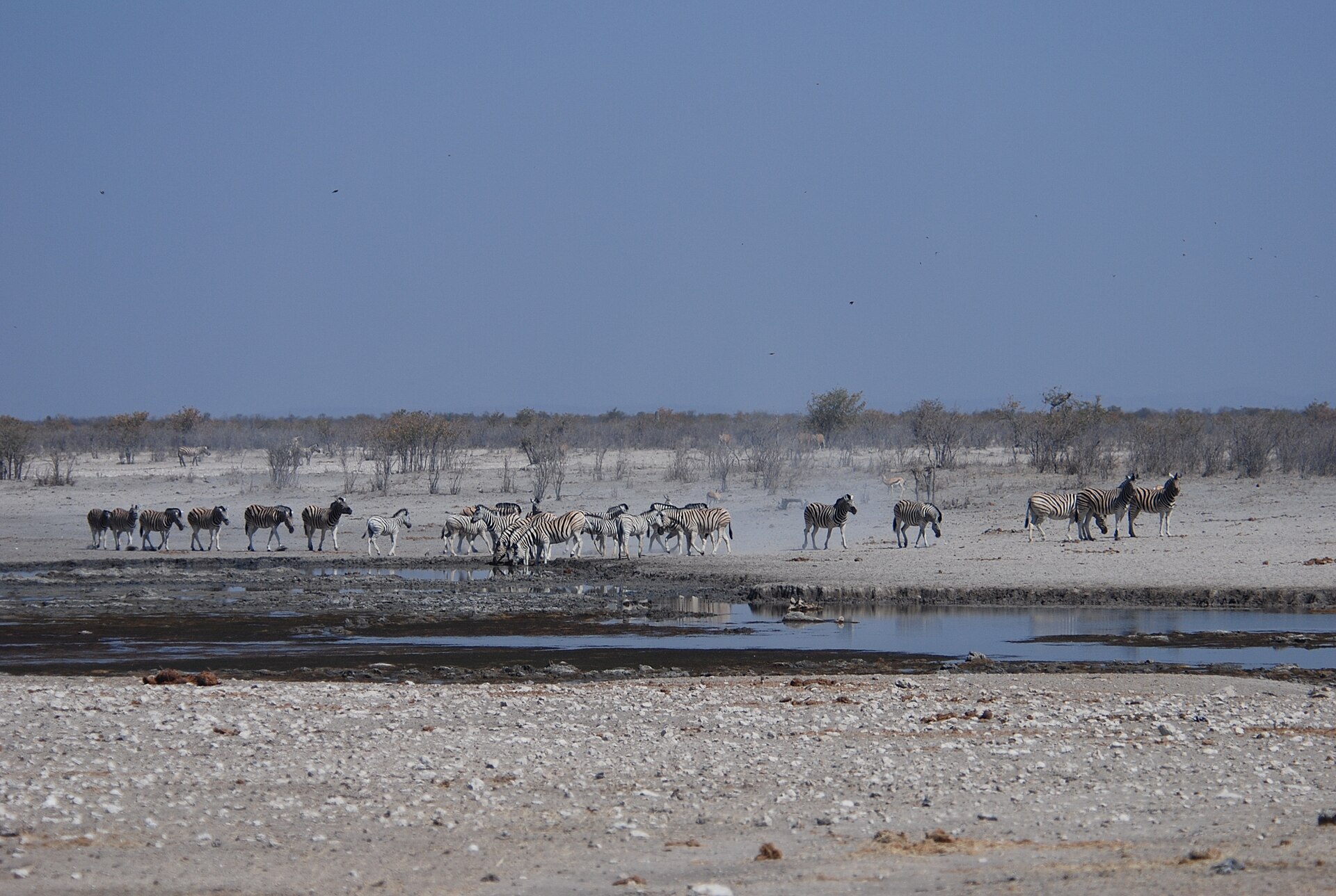
A waterhole day in Etosha is an exercise in attention. The dry season can concentrate wildlife around limited water, but that does not turn nature into a timetable. A quiet pool may stay quiet; a busy one may change in minutes. The useful plan is to cover less ground, watch longer and follow the park’s rules without exception.
Start with a small section of the map
Choose a base and identify two or three waterholes within a sensible loop. Crossing the park simply to collect names creates more driving and less observation. It also increases the risk of reaching a gate or camp later than intended.
Ask at the gate or rest camp about current road conditions and recent animal movement, but treat every report as history, not a guarantee. Staff information can help with direction; it cannot promise that the same animals will be waiting when you arrive.
Use the cooler hours well
Be ready for the gate opening rather than trying to organise bags and breakfast in the vehicle queue. Drive slowly, scan the verges and allow time for other vehicles to stop. Early light can be excellent, but the day is not lost if the first hour is quiet.
At a waterhole, turn off the engine when appropriate, keep voices low and give other visitors a clear line of sight. Watch the whole scene: birds, tracks, nervous herd behaviour and the way different species approach can be as revealing as a single dramatic encounter.
Try a patient sequence: twenty minutes of still observation, one slow scan with binoculars, then a decision to stay or move. Do not leave automatically because nothing happened in the first five minutes.
Make midday useful
The heat and hard light around midday are a reason to change pace, not to speed across the park. Return to a rest camp for shade, water, fuel and a proper break, or choose a nearby waterhole where waiting can be done safely and comfortably inside the vehicle.
Carry more drinking water than you expect to use, plus sun protection and food that does not require unpacking beside the road. Keep cameras and binoculars secure so that excitement does not lead to an open door or a body leaning outside the vehicle.
The rules protect people and wildlife
- Remain inside the vehicle except in places where getting out is explicitly permitted.
- Do not drive between sunset and sunrise; confirm that day’s gate times locally.
- Never block an animal’s route to or from water.
- Do not feed wildlife or use sound to attract attention.
- Drones require official permission and must be declared according to current park instructions.
These are not photography inconveniences. They are the conditions that make shared observation possible. The same principle guides our responsible photography advice: the image never outranks the place.
Finish close to camp
Plan the last waterhole near the correct return route and leave a generous margin before closing. A sighting is not a reason to ignore a gate deadline. If your camp has a floodlit waterhole, the evening can continue from the designated viewing area after the vehicle is parked.
A good Etosha day may include elephants, antelope, zebra, birds or none of the species you expected. Its success is measured by the quality of the watching, not the length of the checklist.
Planning sources: Namibia’s environment ministry Etosha overview; official park regulations; 2025 ministry clarification on park rules; Namibia Wildlife Resorts gate guidance. Confirm gates, roads and permits locally.
Image credit: “Wild animals gathered around a waterhole in Etosha National Park, Namibia, 2007,” Josep M. Gracia, CC BY-SA 4.0, via Wikimedia Commons. Resized by Wikimedia for web use; no editorial alteration.