A useful batik encounter in Yogyakarta begins before a purchase. Learn how wax and dye make a pattern, give the cloth time under your eye, and ask where and how the particular piece was made. You will leave with a better understanding even if your bag stays empty.
Weather note, 29 October 2026: BMKG’s 27 October bulletin includes the Special Region of Yogyakarta in its heavy-to-very-heavy-rain alert for 27–29 October. Check current local warnings and follow local instructions before any journey. Postpone an outing if conditions or access are unsafe; an indoor destination does not remove the risks of getting there.
Learn the process before judging the pattern
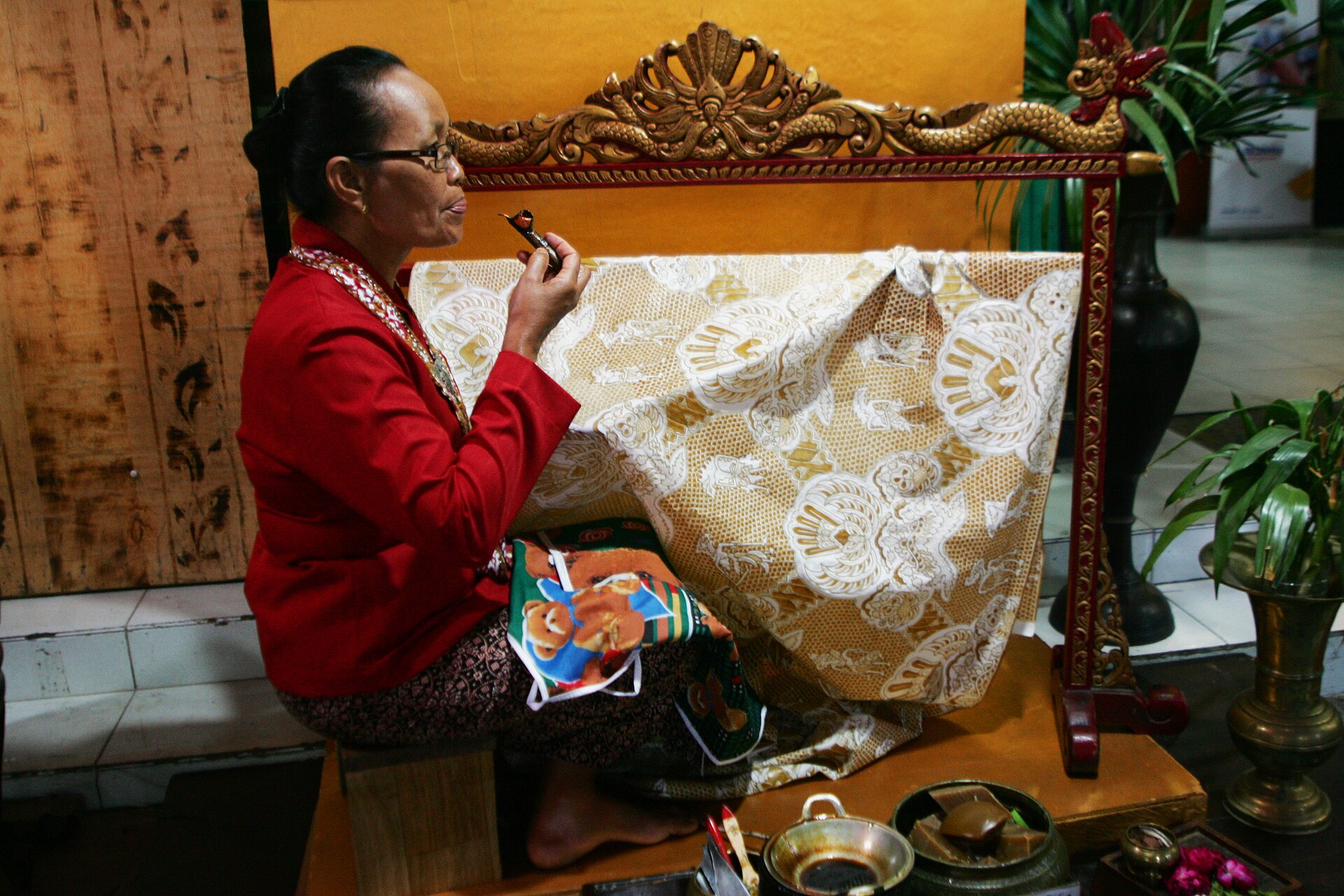
Batik uses wax to resist dye on cloth. For batik tulis, a maker draws the wax design with a canting, a small reservoir and spout. For batik cap, a shaped copper stamp applies the wax. Some pieces combine methods. The Australian Museum’s process guide makes these distinctions clear: stamping the wax is different from simply printing a coloured design on fabric.
In a shop, start with a specific question: “How was this piece patterned?” Ask the seller to explain the stages rather than treating “handmade” as a complete answer. A decorative design may be something you enjoy, but the label should allow you to understand the process you are paying for.
Do not turn this vocabulary into a quick authenticity test. Repetition, small irregularities or colour visible on both faces are things to discuss, not proof you can use to authenticate every cloth at a glance.
Give the cultural context room
UNESCO’s Indonesian Batik entry describes cloth used across everyday life and important family occasions, with meanings carried through designs and colours. That is a reason to ask about context, rather than to assume a motif is merely decorative.
The Yogyakarta provincial government’s April 2026 account of Griya Batik “Jogja Kota Batik Dunia” describes collections connected with Javanese life stages, court traditions and later design developments. It lists the centre at Jalan Patehan Lor 34, Patehan, Kraton, Yogyakarta.
Use that official account as a starting point for a collection visit. It does not provide a confirmed timetable for 29 October. Before travelling, establish the visitor hours, which rooms are accessible and whether someone can explain the textiles in a language you understand. Its description of workshop equipment is not a reservation, a scheduled class or proof that an instructor will be available when you arrive.
When discussing a motif, ask what the maker or interpreter understands it to mean and when it is worn. Accept that an answer may be more particular than a souvenir label suggests. Ask permission before handling cloth, photographing a person at work or entering a work area.
Look at one cloth from edge to edge
Ask to see the whole piece laid out or held safely, if the seller can accommodate that. Look at how the pattern meets the border, how the design changes across its length and what happens at a join. Then consider how you would use it: as uncut cloth, clothing, a scarf or something for the home.
Separate the questions about production. Where was the design developed? Where were the waxing and dyeing done? Who made the finished garment? A shop in Yogyakarta may sell work from several places, and the fabric’s origin need not be the same as the place where it was sewn.
If you are comparing two pieces, write down the stated technique, fibre, size and maker, with permission. Comparing those details is more informative than deciding that a higher price, older-looking label or especially intricate pattern must establish a particular origin.
Before paying, ask about use and care
- Confirm the material and dimensions. For a garment, check fit and seams; for uncut cloth, check that its size suits the purpose you have in mind.
- Ask for care instructions for that piece. Find out what the maker recommends for washing, drying and storage. Do not assume every dye and fibre needs the same treatment.
- Clarify what is included. Establish the final price, any alterations or delivery arrangements, and the actual return terms before agreeing.
- Request an informative receipt. Where process or origin matters to your decision, ask for those claims to identify the item you bought.
A patient explanation can be part of the value of buying directly from someone who understands the work. It is also reasonable to say thank you and leave without a purchase when the description is unclear or the piece does not suit you.
Arrange participation separately
If you want to try batik, confirm a provider, date, language, supervision and the activity itself before setting out. Ask which stages you will do, what materials and fees are included, and when the finished cloth can be collected. A short introduction is not the same as making a completed multi-stage textile from beginning to end.
Keep the journey adaptable in rain, and consult your accommodation or provider about a suitable arrival and collection point. The current Indonesia travel advice also explains weather and natural-hazard precautions. There is no need to add an out-of-town or volcano excursion to make a cloth-focused visit worthwhile.
Continue exploring materials with Gdańsk through amber, or read our Taichung creative-quarter visit for another way to approach small studios thoughtfully.
Sources and photograph
Checked 29 October 2026: Australian Museum: the batik process; UNESCO: Indonesian Batik; the provincial government’s Griya Batik collection account, 6 April 2026; and BMKG’s 27 October weather bulletin. Confirm current access, services and warnings for your visit.
Featured photograph: Proses Pembuatan Batik Tulis, Ivuvisual, 1 October 2019, Wikimedia Commons, CC BY-SA 4.0. Archival batik-making illustration; not a confirmed current Griya Batik demonstration. Resized; responsive crops may apply. Image adaptations retain the same licence.