Katong–Joo Chiat rewards a visit that moves beyond the first photograph. A row of ornamented façades can catch your eye, but a conversation about a dumpling, a piece of beadwork or the use of a shopfront gives the neighbourhood more depth. Choose a small area, one food stop and one craft-related visit rather than trying to collect every colourful house.
This is a suggested way to explore, not an account of a meal we have eaten or a workshop we have attended. Keep the plan flexible enough for a business to be closed, a class to require advance arrangements or the weather to interrupt the walk.
Begin with several histories, not a single label
The Singapore Tourism Board’s precinct guide describes an area long shared by different communities, with strong Peranakan and Eurasian associations. Those traditions should not be treated as interchangeable, nor should every dish or building be assigned the same identity because it is nearby.
Let the people who run a venue describe their own work. Ask how a recipe, material or technique relates to their family or business, if they have time to talk. A good question leaves room for a specific answer rather than demanding a simplified story about the whole district.
The Urban Redevelopment Authority’s Historic East guide adds useful context about the area’s communities and buildings. Use heritage maps to understand the place, not as proof that a business, private interior or old bus route is available today.
Make one food stop a conversation
A practical starting point to investigate is Kim Choo Kueh Chang. Its own website identifies the original location at 60 Joo Chiat Place and an East Coast branch and visitor centre at 111 East Coast Road. These are different addresses: check which one has the products or activity you want, and confirm current retail hours directly before setting out.
Choose a modest purchase and ask what distinguishes it. For a rice dumpling or kueh, useful questions concern the filling, ingredients, serving and storage rather than whether it is the neighbourhood’s most famous example. The answer may help you notice differences that a photograph cannot show.
- Describe dietary needs clearly. Ask about the actual ingredients and preparation, not only the name or colour of the food.
- Buy for the day you have. Ask how something should be kept before carrying it through a long afternoon. Do not assume a freshly bought item will travel well without care.
- Check the total. Understand the portion, price and any packaging charge before ordering.
- Leave room for others. A small counter is also a working space, not a stage for an extended photo session.
If you choose laksa elsewhere, ask the stall about its own version. The tourism board describes Katong laksa with coconut milk and seafood ingredients; that description is not an allergen declaration for every bowl. No restaurant ranking, universal dietary suitability or personal tasting is implied here.
Look closely at craft, and book participation separately
A retail visit and a hands-on class are different activities. Kim Choo’s current activity page lists an introductory Peranakan beadwork workshop at 111 East Coast Road. It explicitly distinguishes that elementary session from making a complete beaded shoe and lists a minimum group size of five.
Do not turn that listing into an assumed walk-in opportunity for one or two visitors. Ask the provider about the actual date, group arrangements, cost, materials and what you can expect to complete. An old printed duration or advertised group price does not confirm an appointment for your visit.
Without a booking, a thoughtful shop visit can still be worthwhile if the business is open. Ask whether an object is handmade, who made it and how it should be cared for. Give the seller time to answer, and accept that some techniques take much longer to learn than a short holiday session allows.
See Koon Seng Road without treating homes as a set
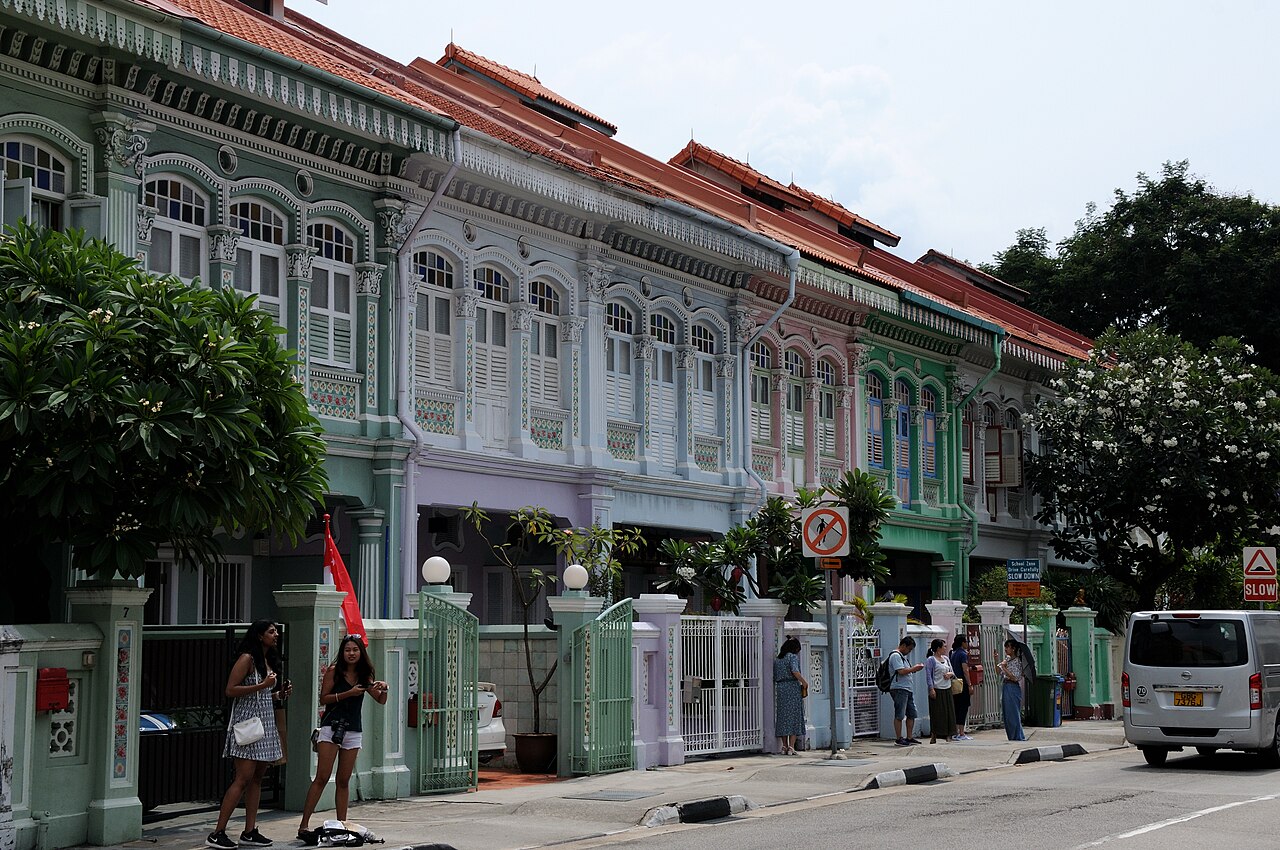
The ornament and colour along Koon Seng Road invite a closer look from public space. Notice window shapes, tile patterns and the rhythm of neighbouring façades. Then put the camera away for part of the walk and see what else you notice.
Keep gates, steps and doorways clear. Do not enter a property, lean on a gate, sit on someone’s steps or photograph through windows to improve a composition. A conserved house remains someone’s space; a heritage map is not permission to cross its threshold.
Stay out of the road for photographs, use crossings and leave a clear way past. Ask before taking close-up pictures of people or the inside of a shop. One considerate photograph is enough; the neighbourhood does not owe visitors an empty street.
Leave the afternoon room to change
24 October check: Meteorological Service Singapore’s current forecast indicated thundery showers over many areas in the afternoon when checked. Recheck the latest forecast and lightning information before and during your visit; a cached “no warnings” line is not a continuing all-clear.
Keep an indoor pause available and be willing to shorten or postpone the outdoor part in poor conditions. Heat, rain and a booked activity should shape the order of stops, rather than a rigid loop or a promised completion time. Check transport for your actual starting point instead of copying bus details from an older map.
For another way to browse makers without rushing, read our Fremantle market experience, or explore more Asia stories. The places are different; the useful habit is to ask before assuming.
Sources and photograph
Editorial checks: 24 October 2026. Sources: Singapore Tourism Board precinct guide, URA Historic East guide, Kim Choo’s own location and activity pages, and Meteorological Service Singapore, linked above. Printed maps provide context, not current opening, transport or booking guarantees. No purchase, reservation or personal attendance is implied.
Featured photograph: Koon Seng Road shophouses, Josep M. Gracia, August 2019, CC BY-SA 4.0. Resized; responsive crops may be displayed under the same licence. Archival street view, not current weather, business opening or permission to enter private property.