A hotel room name can sound precise while leaving the most important questions unanswered. “Deluxe,” “family” and “junior suite” may help a property organise its inventory, but they are not enough to tell you whether everyone can sleep comfortably or whether two people can use the room without disturbing each other.
Read the category as the start of a description, not the conclusion. The useful comparison is between the space you need and the details attached to the room and rate you are actually buying.
Translate the bed description into sleeping places
Check the number of beds, their stated dimensions and whether a sofa bed or rollaway is involved. Do not infer the layout from a photograph of another category, or assume familiar king and queen labels give identical dimensions in every property.
For a double or twin booking, establish whether the bed arrangement is confirmed or merely requested. Two adults who need separate sleeping surfaces should not rely on a preference box whose result remains subject to availability.
If children are travelling, give the full party size and ages. Ask how cots, extra beds and sofa beds affect the actual category, permitted occupancy and charges. A booking screen allowing a search is not the same as written confirmation of every sleeping arrangement.
Ask what makes the upgraded room different
Compare the measurable change: usable floor space, a particular view, a balcony, a different bathroom or a distinct seating area. If the listing gives a size, check whether outside space is counted and look for a floor plan where available.
For a suite, ask whether the living and sleeping areas have a door between them. A larger open-plan room may be comfortable, but it serves a different purpose from a separated space when one person wants to sleep and another needs to work or look after a child.
Consider the room’s everyday use. Where will luggage sit once it is open? Can someone move past the extra bed? Is a desk actually part of this category? These questions are more useful than deciding that one marketing adjective must outrank another.
Distinguish connecting rooms from a proximity request
Connecting rooms have an internal door between them. A request for rooms nearby, on the same floor or adjacent should not be treated as a confirmed internal connection.
Hilton provides a specific example: its Confirmed Connecting Rooms option can confirm eligible connecting combinations at booking through its website or app, at participating hotels and subject to availability. A normal connecting-room request outside that process can still be subject to availability at check-in. Read the programme FAQ and the confirmation for the actual booking; do not generalise the programme to every hotel or booking channel.
Where a connection matters, ask the property exactly what is guaranteed, how the reservation records it and whether both rooms’ categories are specified. “We have noted your request” is a useful acknowledgement, but it is not the same statement as a confirmed room configuration.
Check accessibility as a set of features
If you need step-free access or a particular bathroom arrangement, ask about the features rather than stopping at the accessible-room label. Relevant questions might include the route from entrance to room, lift access, doorway clearances, shower design and the position of support rails.
Ask for the information that matches your needs, and clarify whether the described accessible room is the category being reserved. If connecting rooms are also essential, verify that the required accessible configuration and connection can be confirmed together. Do not assume two individually available categories form a compatible pair.
Read the rate separately from the room
A suitable room can still come with unsuitable booking conditions. For each shortlisted option, check what the specific rate includes: breakfast for how many guests, extra-bed charges, applicable property charges, payment timing and the cancellation deadline with its stated time zone.
Do not let a room upgrade distract from a non-refundable condition, or assume two rates for the same category have identical inclusions. Save the description and written confirmation so you can refer to what was sold, not a category page that may later change.
Send one focused question before paying
Booking note
“For two adults and one child, does this exact room and rate confirm the listed beds, a separate sleeping area and breakfast for all three? Which details remain requests, and what is the full payable amount?” Adapt the question to your actual needs.
First choose a location that works for the trip—our Paris neighbourhood guide illustrates that earlier decision. Then compare room layouts and rate terms. The strongest booking is not the one with the grandest category name; it is the one whose confirmed details answer the questions that matter to you.
Planning sources checked 18 September 2026. Recheck current access, prices and booking conditions for your travel dates.
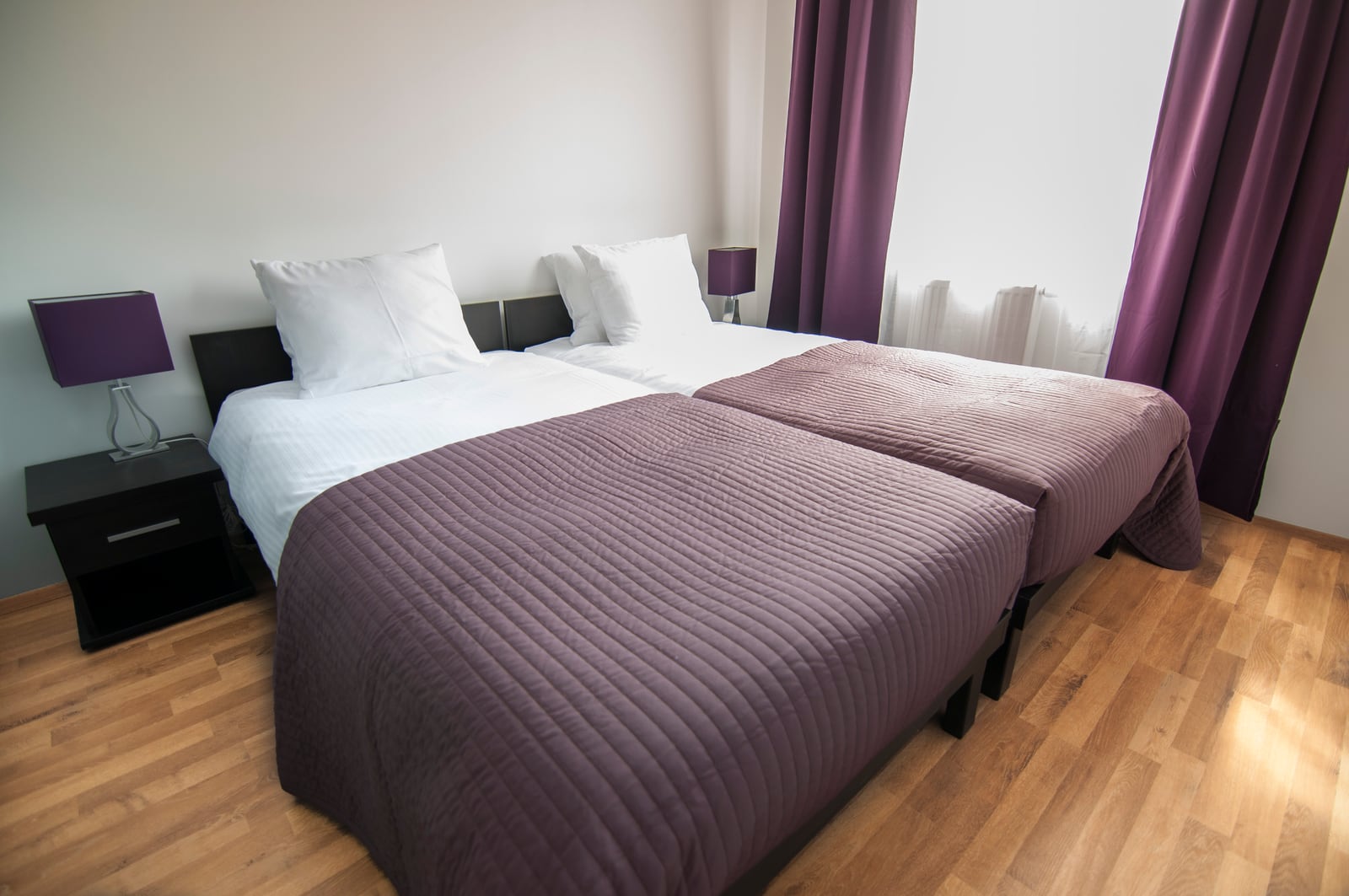
Featured photograph: twin-bed bedroom, photographed in 2014 by IFERREIRO, via Wikimedia Commons, CC BY-SA 3.0. Illustrative archive image, not a property recommendation or guarantee of a bookable layout. Resized and compressed; display crops may apply.