A medina visit can become strangely narrow if the whole experience is spent following a moving dot. Navigation matters, especially on arrival with luggage, but it works best when it creates room to look up rather than demanding constant screen attention.
The Moroccan National Tourism Office describes medinas through their streets, craft activity and historic setting. They are not simply sightseeing mazes. Our approach is to plan the essential movements carefully and leave the smaller discoveries unhurried. Start with the official overview of Morocco’s medinas, then use place-specific information for your chosen city.
Make arrival a separate task
Before travelling, ask your accommodation for the nearest practical vehicle drop-off, the final walking directions and a contact number. Save these with the accommodation’s exact name and address. A map pin is helpful, but it is not always enough to explain which entrance you need or how to reach it with bags.
Ask whether a meeting service is available, where it starts and whether there is a charge. Do this directly with the property rather than assuming an unfamiliar person offering assistance has been sent by your host. If you use a luggage service, agree the destination and price before handing over the bags.
Keep the first arrival walk purposeful. Finding a room, checking in and getting your bearings is already a useful beginning; there is no need to turn that journey into the day’s shopping route.
Give each outing an anchor and a purpose
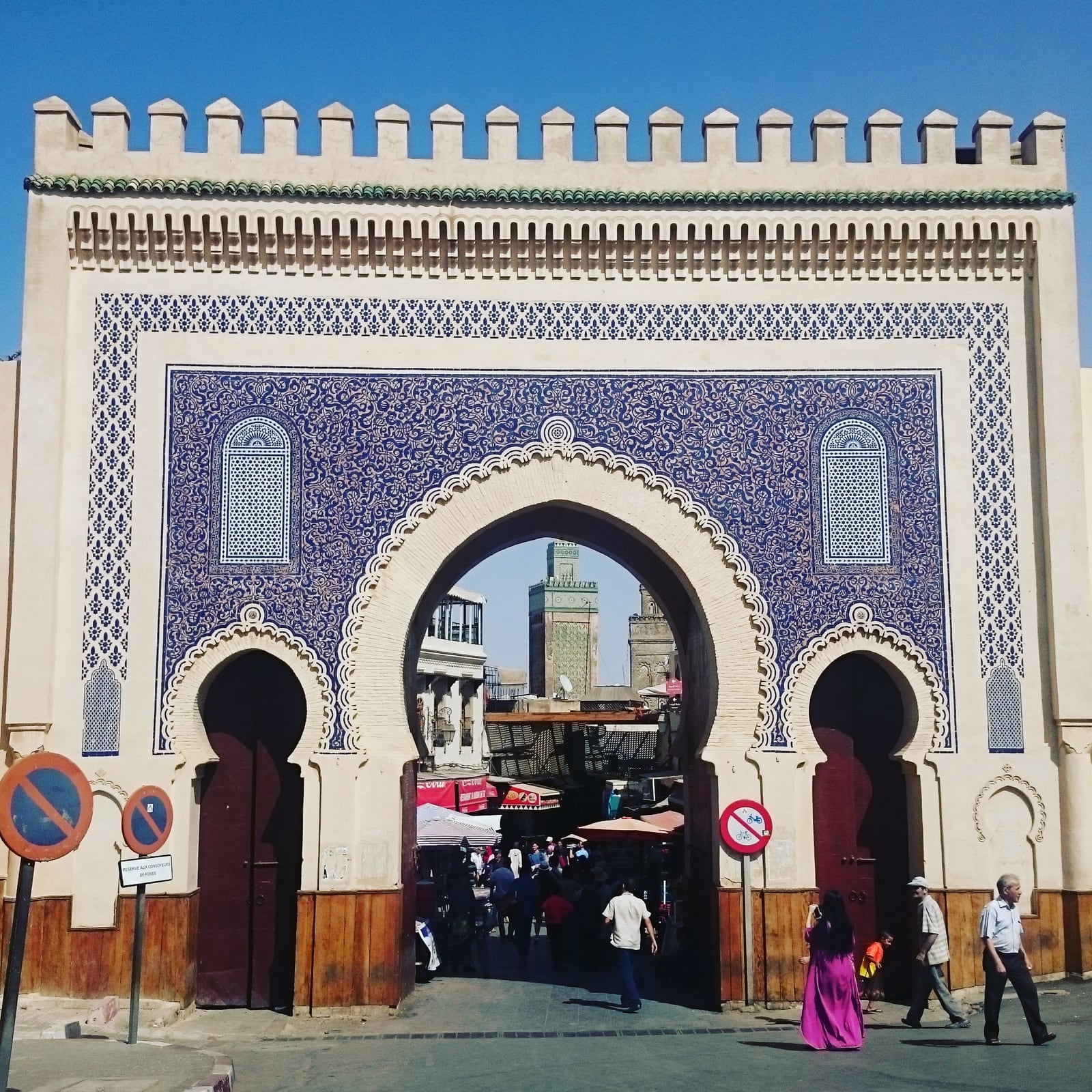
Choose one recognisable public starting point, such as a gate, square or named landmark, and record how you will return to it. In Fez, for example, the tourism office’s medina guide introduces Bab Boujloud as an entry point. It can be a useful anchor for a Fez walk; choose an equivalent reference point that suits your own route and accommodation.
Keep the first outing small: an area to explore, a place to pause and a route back. Adding distant stops because they appear close together on a screen can turn an interesting walk into an exercise in correcting wrong turns. Save an offline map before departure, but keep written arrival information as well.
If you lose confidence in the route, stop somewhere that does not obstruct movement. Reorient there rather than walking faster while staring at the phone. A quiet pause is more useful than several increasingly uncertain turns.
Ask for help clearly
When you need directions, ask a specific, answerable question: which way to a named gate, or whether you are near a named street. A staffed business or your accommodation can be a practical point of reference. Avoid assuming that every passer-by knows an obscure property name.
If someone offers to lead you, distinguish directions from a paid service. Clarify the destination, fee and scope before agreeing. This is a way to make expectations legible on both sides, not a reason to treat every interaction as suspicious.
For a longer or more interpretive walk, ask the accommodation to recommend a reputable local guide. Check credentials and agree the duration, price and any shopping stops beforehand. A guide can add context as well as navigation; decide which of those services you actually want.
Let the street function around you
A walkable lane is not necessarily free of deliveries or other traffic. Stay alert, keep bags close enough not to block passage and step aside for people trying to work or get home. A narrow entrance is a poor place for a lengthy map discussion or a group photograph.
Ask before photographing identifiable people, workshop interiors or activities where permission is uncertain. An open door does not establish public access. Follow signs and local instructions at religious sites, residences and workshops; when access is unclear, ask rather than improvising a rule from another city.
Keep curiosity without losing your return plan
Planning note
Save the accommodation contact and your return anchor before leaving. Then give yourself permission to spend part of the walk observing rather than navigating to the next pin.
Browsing need not become a purchase, and a purchase need not become a negotiation performed for an audience. Be clear about your interest, ask about price before committing and keep conversation respectful. If you want to linger over craftsmanship, make room for that instead of treating it as a delay.
Choose further reading through our Morocco destination collection. The goal is not to eliminate every wrong turn. It is to make essential arrival and return movements dependable enough that the visit can include attention, patience and genuine choice.
Planning sources checked 18 September 2026. Recheck current access, prices and booking conditions for your travel dates.
Featured photograph: Bab Boujloud (Blue Gate), Fez, photographed in 2016 by Sgroey, via Wikimedia Commons, CC BY 4.0. Resized and compressed; display crops may apply.