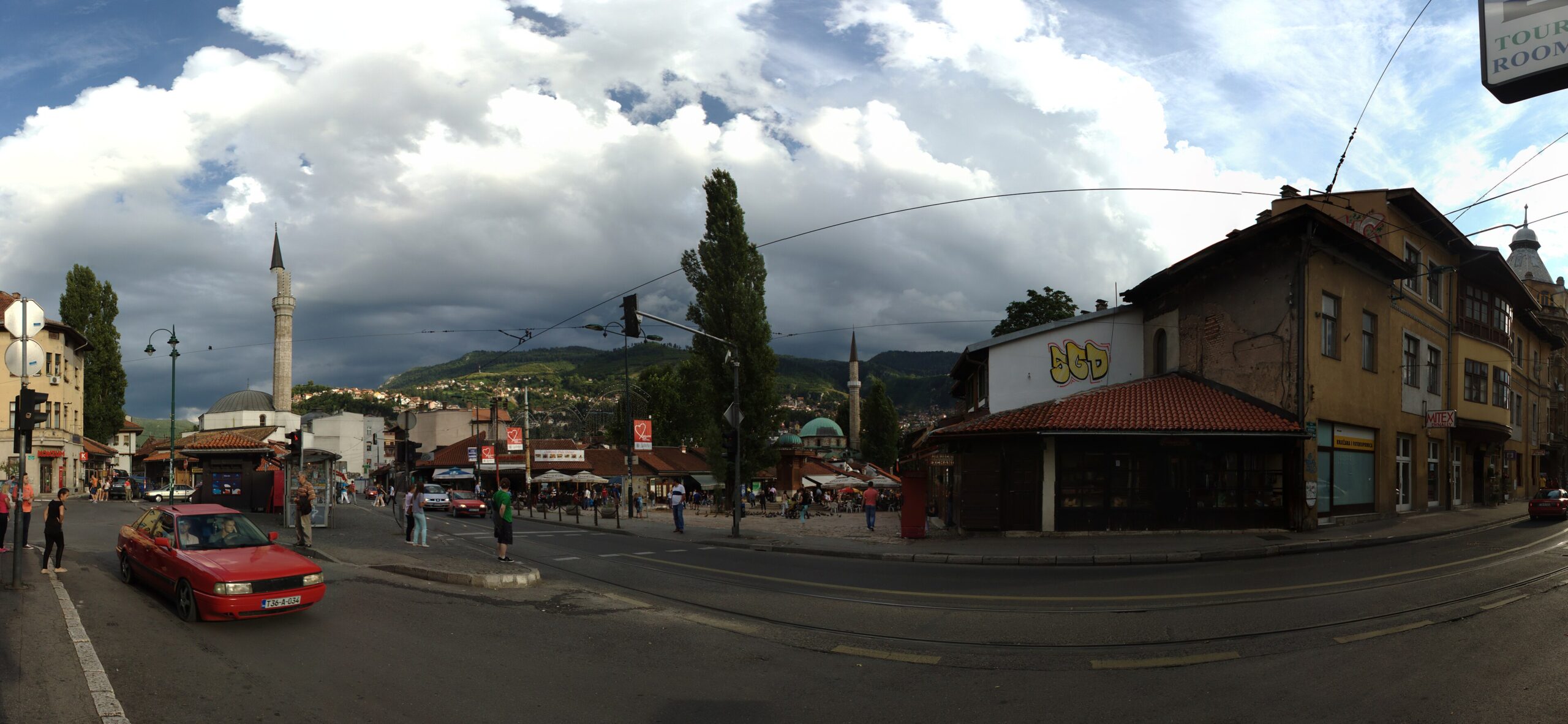
Sarajevo makes its history unusually visible. Start among the low shopfronts and courtyards of Baščaršija, then walk west until Ferhadija opens into a different architectural rhythm. This is not a checklist of monuments or a simplistic “East meets West” tour. It is a compact, mostly level day that treats the city’s Ottoman and Austro-Hungarian layers as parts of the same living capital.
The route at a glance
- Morning: Baščaršija, Sebilj and the lanes around the Gazi Husrev-beg complex
- Late morning: the Sarajevo Meeting of Cultures marker and Ferhadija
- Afternoon: Latin Bridge and the Museum Sarajevo 1878–1918
- Evening: City Hall and an easy riverside finish
- Rain plan: substitute Brusa Bezistan or another Museum of Sarajevo annex for the longest outdoor stretch
Allow six to eight hours with lunch and museum time. The core walk is short enough that the day still works if rain, prayer times or a long coffee pause change the order.
Morning: let Baščaršija set the pace
Begin early at Sebilj, before the busiest groups fill the square. The point is not to photograph every lane. Walk slowly enough to notice the changes in scale: copperware workshops, timber-framed upper floors, courtyards, fountains and the quieter edges around the Gazi Husrev-beg complex.
Religious buildings here are active places of worship. Dress with shoulders and knees covered, keep voices low, and do not assume visitors may enter during prayers. A courtyard can be the better experience when access is limited.
Editorial note: Sarajevo’s architectural layers are not a theme park of competing empires. Treat the route as a way to read a living city, not as a hunt for a neat border between “East” and “West.”
Cross the city’s most useful line
At the western edge of Baščaršija, look for the pavement marker called Sarajevo Meeting of Cultures. The official city guide uses this point to explain the visible transition between the Ottoman market quarter and the Austro-Hungarian centre. Stand here for a moment, then continue along Ferhadija rather than doubling back.
The shift is gradual but unmistakable. Streets broaden, façades become more formal and cafés occupy a different urban frame. Keep the route simple: Ferhadija is the spine, and small detours should return to it. That restraint gives the day coherence.
Use one museum for context
Turn toward the Miljacka for Latin Bridge and the Museum Sarajevo 1878–1918. The museum occupies the building beside the site associated with the 1914 assassination of Archduke Franz Ferdinand. Its renewed permanent display reopened in October 2025, making it the most focused indoor stop for this route.
Do not try to fit every museum annex into one afternoon. If the 1878–1918 museum is closed or crowded, Brusa Bezistan in Baščaršija provides a broader archaeological and urban-history alternative. The Museum of Sarajevo currently lists Sunday closures and shorter Saturday hours for its main annexes, so check the official schedule before setting out.
Finish with City Hall and the river
From Latin Bridge, follow the river east toward Vijećnica, Sarajevo City Hall. Its ornate façade gives the day a strong final image without requiring another long transfer. If the weather holds, cross the river and walk back at water level; if it does not, end inside City Hall or retreat to a café near Baščaršija.
At sunset, resist the temptation to add a distant viewpoint just because it appears on a map. This itinerary works because its history unfolds on foot. Save the cable car and the hills for another day.
A practical weather switch
- Light rain: keep the full route and use arcades, covered market lanes and café stops.
- Steady rain: shorten Baščaršija, add Brusa Bezistan, then continue to the 1878–1918 museum.
- Sunday: expect Museum of Sarajevo annexes to be closed; focus on streets, worship spaces where access is permitted, City Hall and the river.
- Cold evening: finish at Vijećnica rather than forcing a hillside viewpoint.
Before you go
Wear shoes with grip for polished stone, carry a light layer after sunset and keep small cash for markets and cafés. Opening hours, worship access and ticket prices can change, so verify them on the day rather than building the route around a single timed entry.
If you enjoy cities where art, architecture and rivers help organize a weekend, continue with our Dresden museums-and-Elbe plan.
Sources and image credit
Practical information checked 28 September 2026 against the Museum of Sarajevo’s official visitor information, its announcement of the renewed Sarajevo 1878–1918 display, and the official Sarajevo Navigator. Featured image: panoramic view of Baščaršija by Aktron / Wikimedia Commons, licensed CC BY 3.0.