A good food day in George Town needs space between the plates. Rather than chasing ten famous dishes, choose a small breakfast, one substantial lunch and an evening tasting, then let Penang’s heritage streets fill the gaps. You will notice more—and still have an appetite when the next promising stall appears.
This is a flexible city experience, not a reservation list or a promise that a particular hawker will be trading. October does not guarantee dry walking weather. Keep an indoor pause available, check the day’s conditions and make the food stops fit your appetite rather than the other way around.
Begin with breakfast, not a checklist
Start close to where you are staying. A modest breakfast and a drink are enough to get the day moving; crossing town for a supposedly essential first bite can turn an enjoyable morning into a logistical exercise. Look at what is actually being prepared, ask what is available and choose something you want to eat.
In a shared eating space, find out how ordering works before sitting down. Food and drinks may be sold by different operators, and a table is not necessarily a single restaurant’s table. Ask whether to order at the stall or from your seat, where to pay and whether there are any seating conditions. Carry a payment method the vendor accepts rather than assuming every small purchase can go on a card.
Choose one main bowl—and know what you are ordering
Penang Global Tourism’s food guide is a useful starting point for dish names. Three possibilities give you very different lunches:
- Assam laksa: rice noodles with a sour fish-and-tamarind broth. It is not a vegetarian dish simply because it arrives in a bowl of soup.
- Penang Hokkien mee: noodles in a prawn-and-pork broth. This local meaning matters when comparing menus elsewhere.
- Char koay teow: stir-fried flat rice noodles. Ask about the ingredients in the particular stall’s version rather than treating the name as a complete ingredient list.
Choose one as the day’s main meal. If you are sharing, check that sharing is welcome and order a portion that makes sense for the group. There is no need to turn every tasting into a full second lunch.
Useful questions are simple: “What is in this version?”, “How much is this portion?” and “Is the drink ordered separately?” Explain dietary requirements directly. Sauces and stocks deserve the same attention as visible toppings; a dish that looks meat-free is not necessarily suitable for your needs. If the answer is unclear, choose another option instead of making an assumption.
Let the heritage streets connect the meals
Between food stops, use the official George Town heritage map to choose a compact route through the historic centre. Armenian Street and the Beach Street area offer a starting framework, not a demand to follow every detour. Select a few streets that connect naturally with your lunch, then stop when a shopfront, courtyard entrance or building detail catches your attention.
UNESCO’s listing of Melaka and George Town recognises a multicultural trading-city heritage expressed in architecture and everyday cultural life. That context is more useful than treating the centre as a collection of photo spots. Shops, places of worship and homes have their own purposes; open doors are not an invitation to enter or photograph people.
Use the map for orientation, but follow current signs and access arrangements on the ground. For another way to balance eating and exploring, our market-led first day in Valencia also leaves room between the food stop and the next chapter of the city.
Visit the clan jetties as neighbourhoods
If conditions and energy allow, make the Weld Quay clan jetties an optional part of the day. Penang’s tourism bureau describes their origins in communities of stevedores and fisherfolk, with homes built over the water. They are living neighbourhoods, not extensions of a food itinerary.
Stay on clearly permitted visitor routes, respect signs and leave access to homes unobstructed. Ask before photographing residents or their domestic spaces. Do not assume every jetty has the same visiting arrangements, or that a shop being open gives access beyond it. A short, considerate visit is better than insisting on reaching every walkway.
Leave something for the evening—and a wet-weather version
For the final food stop, choose the dish you still feel curious about. That might mean a small savoury plate or chendol: shaved ice with coconut milk, palm sugar and other accompaniments. It need not mean both. Check the vendor’s version and portion before ordering, and accept that an earlier stall may have finished for the day.
If rain interrupts the plan, shorten the street circuit and settle into an open indoor eating place or café. Check its seating and ordering arrangements, buy something appropriate and let the outdoor part wait. The jetties can be skipped entirely. George Town’s appeal does not depend on completing a route: a carefully chosen bowl, a few attentive streets and time to linger are already a worthwhile day.
Sources and photograph
Checked 6 October 2026: Penang Global Tourism’s food guide; its clan-jetties directory and 2026 heritage map; and the UNESCO World Heritage listing. The route and pacing are Travel2Travel’s editorial suggestions; stall availability, menus and access can change.
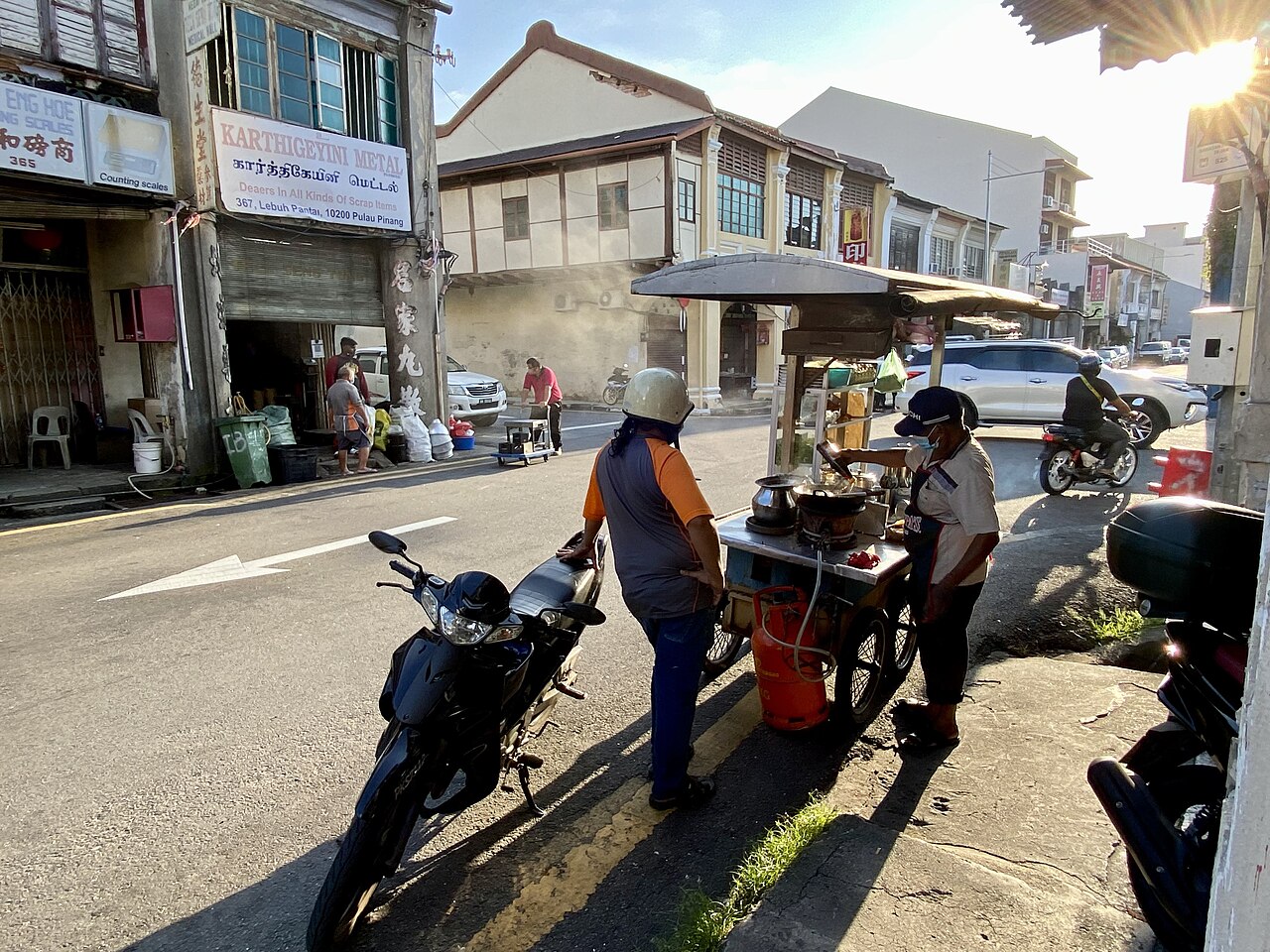
Featured photograph: Beach Street 4 by Slleong, via Wikimedia Commons, CC0 1.0. Archive photograph dated 27 December 2021, resized for publication; not a claim about the pictured stall’s current operation.