Galle Fort is easier to enjoy when you stop treating its walls as a route you must complete. The historic quarter contains homes, businesses, places of worship and people with ordinary errands. Begin with a few streets and one heritage stop, then decide whether a short rampart section belongs in the day at all.
In October, leave room for rain decisions before you leave your accommodation. A photograph of the lighthouse under a bright sky is not a forecast, and a visit to a coastal town does not need to become a beach plan. This guide is about cultural visiting and practical restraint, not swimming or sea conditions.
Read the fort as a town, not an empty monument
UNESCO’s account of Galle emphasises the interaction of European planning and South Asian architectural traditions. Look at the buildings from the public street: shaded verandas, rooflines and the relationship between a house and the narrow space outside it. The heritage story includes local adaptation and craftsmanship, not only the names of colonial powers.
UNESCO also notes that residential and public uses continue. That matters to the visitor. A picturesque doorway may belong to someone’s home; a veranda may be private; a quiet street may still carry vehicles and deliveries. Keep entrances clear, avoid blocking the lane for a photograph and never interpret an open door as an invitation to explore.
Choose a compact street wander and allow time to look carefully at two or three details. Ask your accommodation or a local information point for a current map and any access restrictions. Save your return meeting place before setting off. If your group becomes separated, a specific café or gate-side pickup point is more useful than “somewhere in the fort”.
Give one indoor heritage stop a real purpose
The Central Cultural Fund’s Galle museum page describes maritime archaeology in a historic Dutch warehouse above the Old Gate. Its themes include trade, shipwreck finds and coastal maritime culture. This offers a useful indoor anchor: it connects the port-facing setting outside with objects and interpretation rather than adding another photo stop.
Confirm the actual venue name, current opening, admission, last entry and accessible entrance before building the day around it. Different institutions and listings can use similar museum names. The CCF page checked on 9 October 2026 did not provide a dependable visitor timetable, so this guide does not invent one. Ask whether the galleries you want to see are available and follow posted photography rules.
Inside, choose one object and read what it tells you about movement: a voyage, a material or an exchange across the sea. Do not expect every item described online to be displayed that day. If the museum is unavailable, a verified open cultural venue can be a substitute; an unplanned shop visit is not the same as seeing a collection.
Make sacred-site visits optional and respectful
Approach a church, mosque or other place of worship as an active institution, not simply an interior on a heritage checklist. Read the entrance instructions and ask whether visitors are welcome at that time. Follow the site’s dress, footwear and photography requirements. A public exterior and a tourist-map listing do not establish permission to enter during worship.
Keep voices low and give people room. Do not photograph a service or an individual at prayer without explicit permission. If access is restricted, accept the answer and continue; you can appreciate the street and architecture without asking someone to interrupt their day to make your itinerary possible.
Treat rampart walking as a weather decision
Check the Sri Lanka Department of Meteorology forecast and advisories for your actual visiting date. Its 5:30am forecast for 9 October 2026, checked during preparation, mentioned afternoon showers or thunderstorms across much of the island and locally heavier rain in the Southern Province. That is a dated planning signal, not a forecast for every October visit. Check a fresh issue, its date and the area it covers before departing.
If conditions are suitable, choose a short, permitted public section and an easy way back to the streets. Do not commit to a complete circuit or a fixed sunset photograph. Keep away from edges and barriers, watch uneven surfaces and follow any closures. The lighthouse can be appreciated from public space; this guide does not promise entry to the tower.
When thunder, strong wind or heavy rain develops, leave the exposed walking plan and seek a substantial indoor place. A tree, a narrow overhang or a photograph stop is not a reason to wait out a storm beside the water. Do not use an umbrella as justification to continue along a slippery or exposed route. Local warnings and staff instructions take priority over this suggested day.
- Carry footwear suited to wet, uneven walking and a light rain layer.
- Save a sheltered pause and return pickup point before starting.
- Ask about steps and access if mobility requirements affect the route.
- Drop the rampart segment before shortening a worthwhile indoor visit.
Browse without making everyday life a performance
Take lunch or a drink where the business is open and fits your needs. When shopping, ask about materials, makers and prices. An old setting does not prove that an object is antique or locally made. A friendly conversation does not oblige either person to buy, pose for a photograph or provide a long historical explanation.
Our Fort Kochi and Mattancherry cultural day uses the same distinction between a heritage quarter and a living neighbourhood. In Galle, a successful visit can be one museum, a few carefully observed streets and a decision to leave the walls for better conditions. That is a complete day, not a failed attempt at the longer version.
Sources and photograph
Heritage context, museum information and the dated weather planning check were reviewed 9 October 2026 against UNESCO, the Central Cultural Fund and Sri Lanka’s Department of Meteorology, linked above. Verify current access, venue hours and fresh warnings before travel. No museum opening, lighthouse entry or safe sea conditions are guaranteed.
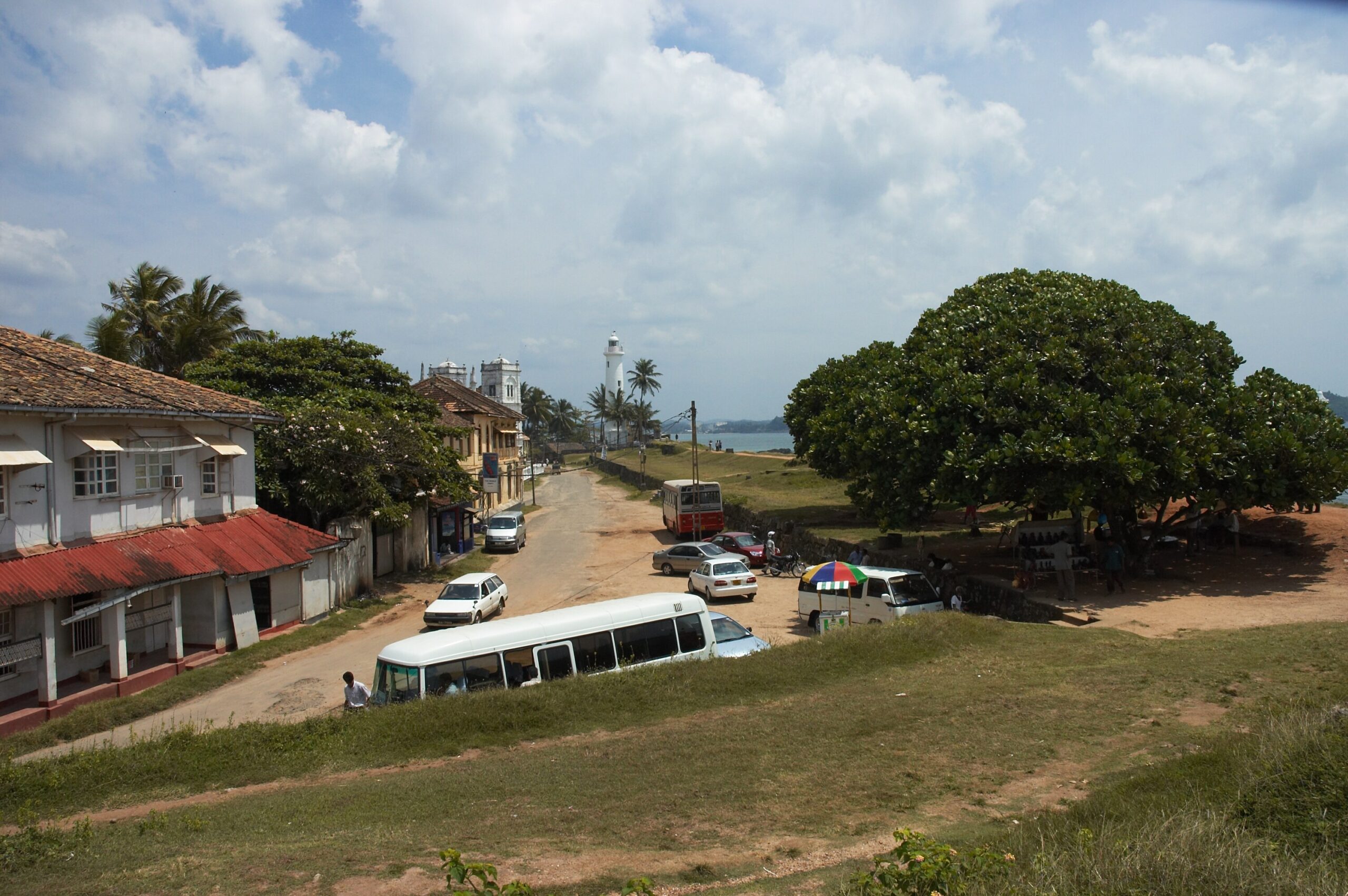
Featured photograph: Galle Fort’s streets and lighthouse looking east, photographed 21 February 2006 by Wouter Hagens, via Wikimedia Commons, using its CC BY-SA 3.0 licence. This archival view does not show current street surfaces, traffic, access or weather. Original photograph; display resizing or cropping where needed, with derivatives under the same licence.
