At Cork’s English Market, a good question can be more rewarding than another item on a tasting list. Ask where a cheese was made, how a fish was smoked or what a trader would suggest for the way you plan to eat it. The answer can connect a busy counter to the people and places behind its food.
Make this a visit with a purpose: choose two kinds of food you would like to understand, allow a conversation when the counter is free, and buy only what you can sensibly use. The market remains a place for ordinary shopping, so its daily work should set the pace.
Start with the name, then look at what is being sold
Cork City Council dates the market’s creation to 1788, under the Protestant or “English” corporation that then governed the city. Its history explains how the name distinguished this market from the later “Irish Market”. It is a piece of municipal history, not a description of a market devoted only to English food.
Keep that distinction in mind as you browse. A familiar name on a label might describe a style, an ingredient or a place of production. Those are different things. The useful story is the one attached to the particular product in front of you, rather than a general claim that everything in a historic market must be local.
Follow a cheese back to its maker
The council’s trader directory lists Toonsbridge Dairy, whose profile describes cheeses made in an old creamery in Inchigeelagh, West Cork, using cow, sheep and buffalo milk. Mediterranean styles and a West Cork place of production can sit together in the same story.
If the counter is open and a cheese interests you, begin with its name and milk. Ask where this particular cheese was made and whether its texture is best suited to eating as it is or cooking. The directory gives context; it does not establish which seasonal products will be on the counter that day.
If you are buying for later, explain how long you will be away from a fridge and ask about storage and transport. A generous portion is not a bargain if it will spend the rest of a city day in unsuitable conditions. Check ingredient and preparation questions directly if they affect what you can eat.
Ask what the smoke has changed
Hederman’s Smoke House is another business in the council directory. Its profile describes timber-smokehouse production and smoked fish. It offers a different line of enquiry: process, rather than simply origin.
Ask which fish or preparation you are looking at and how it is intended to be served. You might ask about the difference between two products, what accompanies one of them, or what storage it needs. Let the trader explain the actual item instead of assuming that all smoked fish has the same texture or use.
These are two possible starting points, not a compulsory pair of purchases or a claim that a tasting will be offered. Check the business’s current service and stock before making a special journey. If a counter is busy, another part of the market may provide a better moment for a conversation.
Make room for the people shopping beside you
The council’s visitor guidance asks people to respect trading, keep narrow aisles clear and avoid moving through the market in large groups. It identifies 11:00–16:30 as the generally busier trading period, particularly on Fridays and Saturdays. Going outside that window may make a shorter, quieter visit possible, but no time guarantees an empty aisle or an available trader.
Stand clear while deciding what to buy. A conversation about production is welcome only when the person working has time for it; let them serve another customer without having to negotiate around your bags or camera. Ask before photographing staff or the preparation of food.
For organised groups, use the council’s registration arrangements rather than arriving as a large informal tour. For an individual visit, two focused stops can be enough. The aim is to understand something about the food, not to finish every aisle.
Turn what you learn into a practical purchase
- For something to eat soon: ask whether the product is ready to eat and where it is appropriate to sit or consume it. Do not assume a retail counter provides seating.
- For cooking later: ask about a manageable quantity, preparation and keeping conditions.
- For taking home: consider storage and the rules of your onward journey before buying perishable food.
- For a short visit: choose one product and one question. A small purchase can still lead to a useful introduction.
A separate café stop can give you time to recall what you have learned. Our Reading Terminal Market story looks at planning a meal within a working market, while the Gdańsk amber guide explores how to distinguish a material’s origin from the work of the person selling it.
Check the Monday details
On our 2 November 2026 check, Cork City Council listed public opening as Monday–Saturday, 08:00–18:00, with closure on Sundays and bank holidays. Individual traders can operate different hours. Check the current market information and your chosen business before relying on an early or late stop; the general building hours do not promise every counter will be serving.
The council notes limited public toilets, with one on the ground floor near the fish aisle. If an entrance, toilet, space to move or reliable seated rest will determine your visit, confirm the specific arrangement before arriving. Keep your journey flexible in autumn weather and read Met Éireann’s Cork warnings before setting out.
Sources and photograph
Checked 2 November 2026: Cork City Council’s market history, visitor guidance, opening information and the two trader profiles linked above; and Met Éireann. Product ranges, prices and individual service can change. No tasting, booking or personal visit is implied.
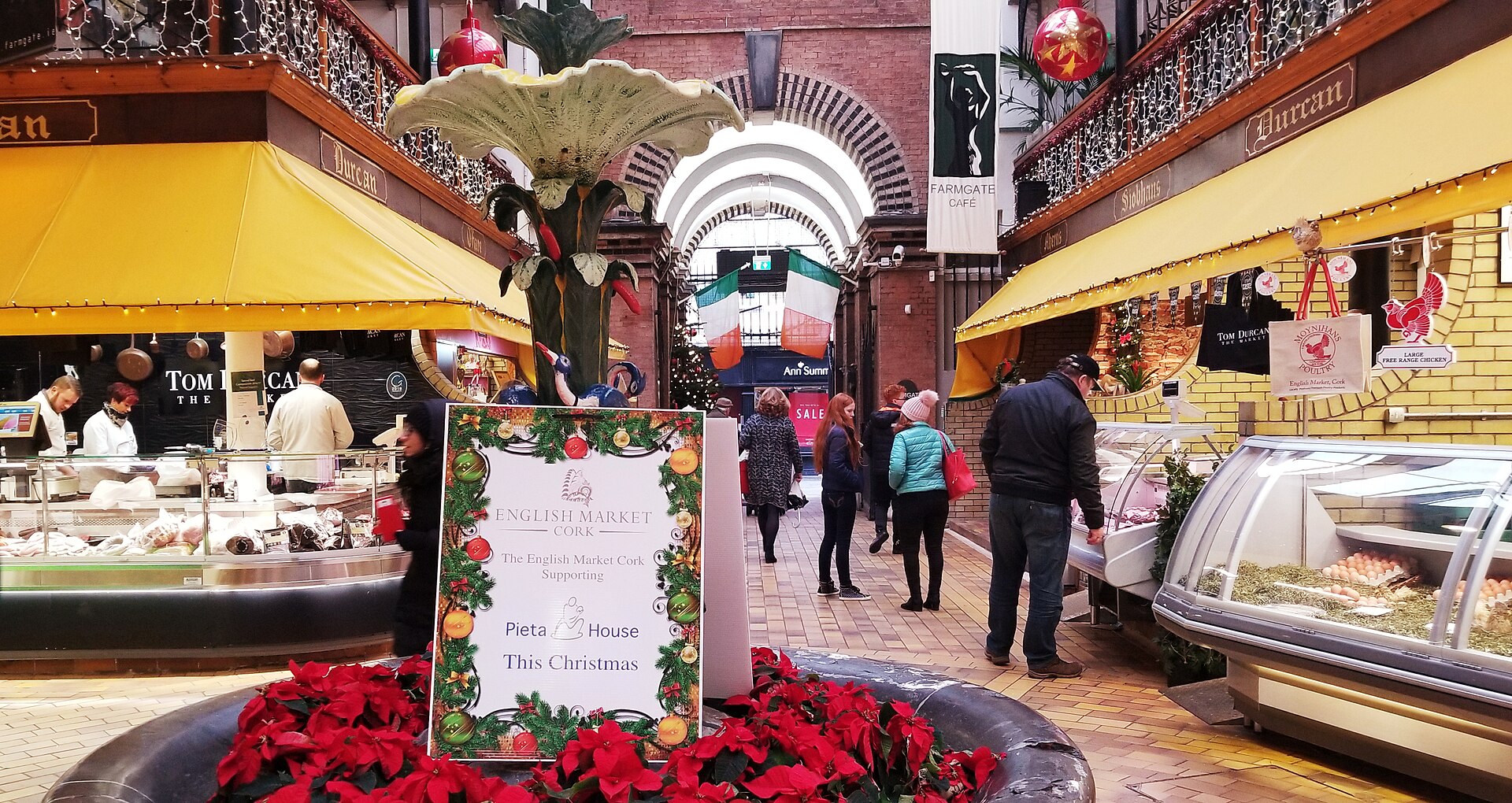
Featured photograph: English Market, Dan Curran, 29 December 2017, via Wikimedia Commons; CC BY-SA 4.0. Resized; responsive crops may vary and retain that licence. The archival image includes Christmas decorations and a historic notice; it does not describe November 2026 decorations, traders, prices or promotions.