Amber is easy to notice in a Gdańsk shop window and harder to understand from a price tag. Give the material some attention before deciding whether to buy it: start at the Amber Museum, follow the change from natural resin to worked object, then take a few precise questions into a conversation with a maker or retailer.
This makes a satisfying visit even if you leave without jewellery. The aim is to look more closely at one material and the decisions people make with it.
Start at the Great Mill
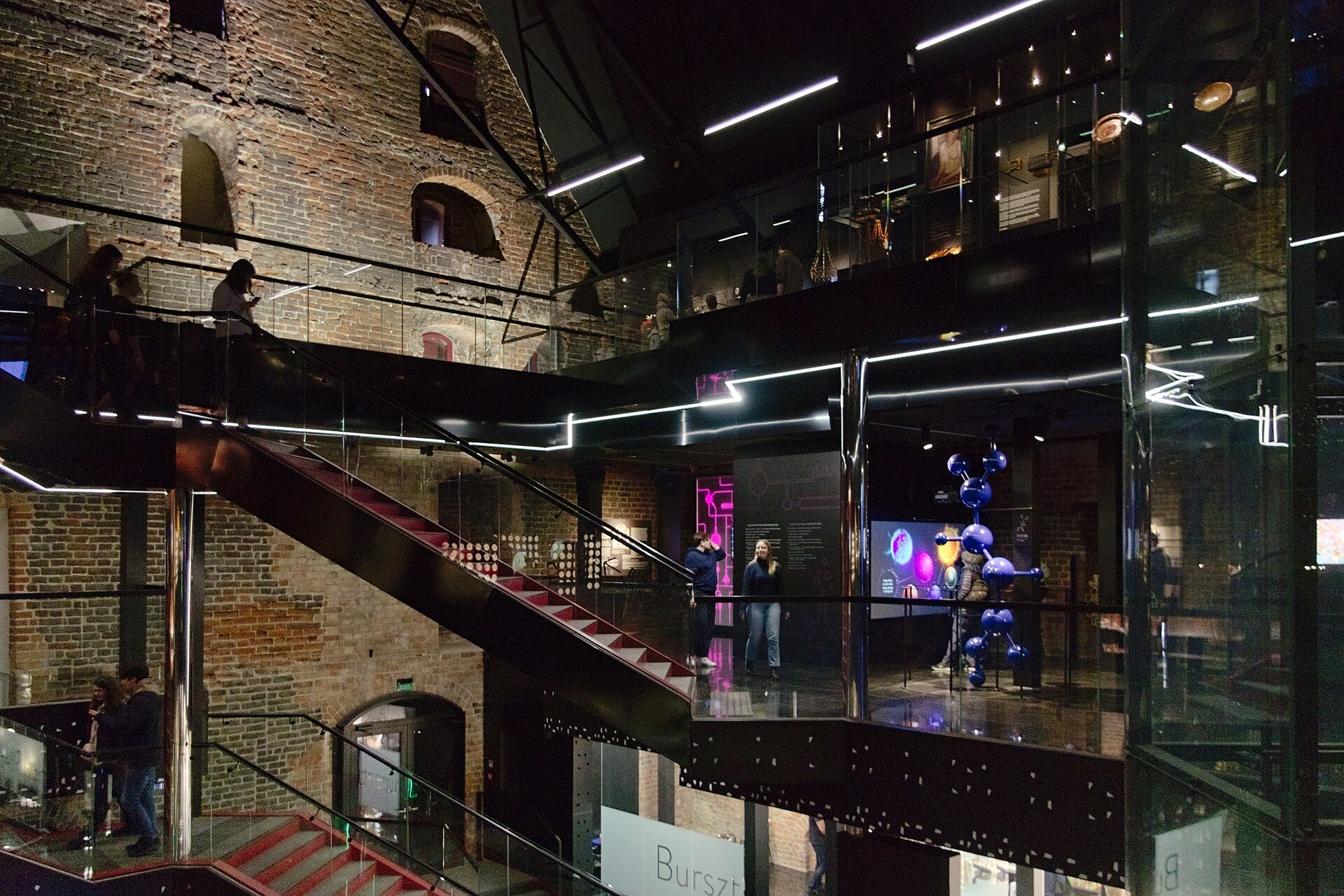
The Amber Museum, or Muzeum Bursztynu, is in the Great Mill at Wielkie Młyny 16. Older references to the Prison Tower and Torture House describe its former home. Use the current address when planning your arrival.
The museum connects amber’s natural history with its use in historic objects and contemporary art. Begin by looking at the material before concentrating on a finished piece. What draws your eye: translucency, opacity, an irregular outline or the way light changes a surface? Read the label rather than deciding that every object must have the same origin or treatment.
Then choose one worked object and give it several minutes. Look at how the setting supports the amber, where the maker has preserved an uneven edge and where cutting or polishing has imposed a new shape. Let the object, rather than a sequence of photographs, set the pace.
Build the visit around the current timetable
On our 28 October 2026 check, the operator’s current visitor page listed Wednesday opening of 10:00–18:00, with ticket sales ending an hour before closing. The displayed standard ticket was 37 zł and reduced admission 26 zł; eligibility requires the appropriate evidence. The page also flags closure on 1 November. Recheck that page for your date and branch before departure.
Allow around two hours as a comfortable planning choice, with a pause when your attention starts to fade. Starting late enough to squeeze past the ticket deadline is a poor way to enjoy detailed displays. A morning visit leaves the afternoon flexible for lunch, a conversation about craft or simply a rest.
For access planning, the operator identifies the wheelchair entrance at the rear courtyard on the Na Piaskach side and lists a visitor lift. Ask the museum about your particular requirements and current arrangements before travelling.
Learn the words behind “amber”
Amber is fossil resin, but that description alone does not tell you how a jewellery component was made. The International Amber Association’s published classification distinguishes mechanically worked natural Baltic amber from material modified by heat or pressure, pressed material made from amber pieces, and bonded constructions.
Those distinctions are useful shopping vocabulary. A treatment or construction deserves a clear description; it should not be hidden behind a broad claim such as “real amber”. Equally, a modified piece may still be something you like. Decide what you want to own and ask for a description precise enough to compare it fairly with another object.
You do not need to become an appraiser in an afternoon. Treat the museum as a place to improve your questions, not as a shortcut to authenticating everything in a shop window.
Questions for the maker or retailer
- What exactly is the material? Ask whether it is Baltic amber or another stated material, and how that identification was established.
- Has it been modified, pressed or bonded? Ask for any treatment and construction to be described in writing, rather than interpreting colour or clarity yourself.
- Where was the object designed and made? Separate the claimed source of the material from the place where the jewellery was produced.
- What are the other components? Check the metal, clasp, fittings and any coatings, as well as the amber element.
- What documentation comes with this particular piece? Ask for an itemised receipt, care guidance and the terms that actually apply. If a report is offered, ask who issued it and whether it identifies the object you are considering.
A shop’s location, a souvenir label or a certificate-shaped card is not an independent guarantee. If the answer remains vague, you can pause or leave. Avoid improvised tests with heat, chemicals or scratching: a purchase conversation should not become an experiment on somebody else’s stock.
Leave room for a decision
Set your spending limit before entering a shop and compare descriptions rather than chasing the largest piece. Consider whether the fastening suits how you would wear it and whether the object still appeals when you stop thinking of it as a holiday purchase.
If you are uncertain, write down the maker’s name and the questions left unanswered, then take a break. A museum visit and a thoughtful conversation already make a complete amber day. Buying is optional.
No workshop or temporary exhibition is necessary for this plan. Check the museum’s dated programme if you want to add one; a listing from another October day does not establish availability today.
Continue the habit of looking closely with our Antwerp design guide. For another measured approach to a Baltic city, read Vilnius at a slower pace.
Sources and photograph
Checked 28 October 2026: Amber Museum overview; the operator’s current branch hours, prices and access information; and the International Amber Association classification reproduced by Amber Portal. Confirm visitor arrangements for your own date.
Featured photograph: Gdańsk Amber Museum interior in the Great Mill, Adrian Tync, 17 February 2024, via Wikimedia Commons, CC BY-SA 4.0. Archival interior view, not a promise of the current display. Resized version; responsive crops may apply. Image adaptations retain the same licence.